Asahi from a Physical Therapist's Point of View
 Asahi Nordic Institute
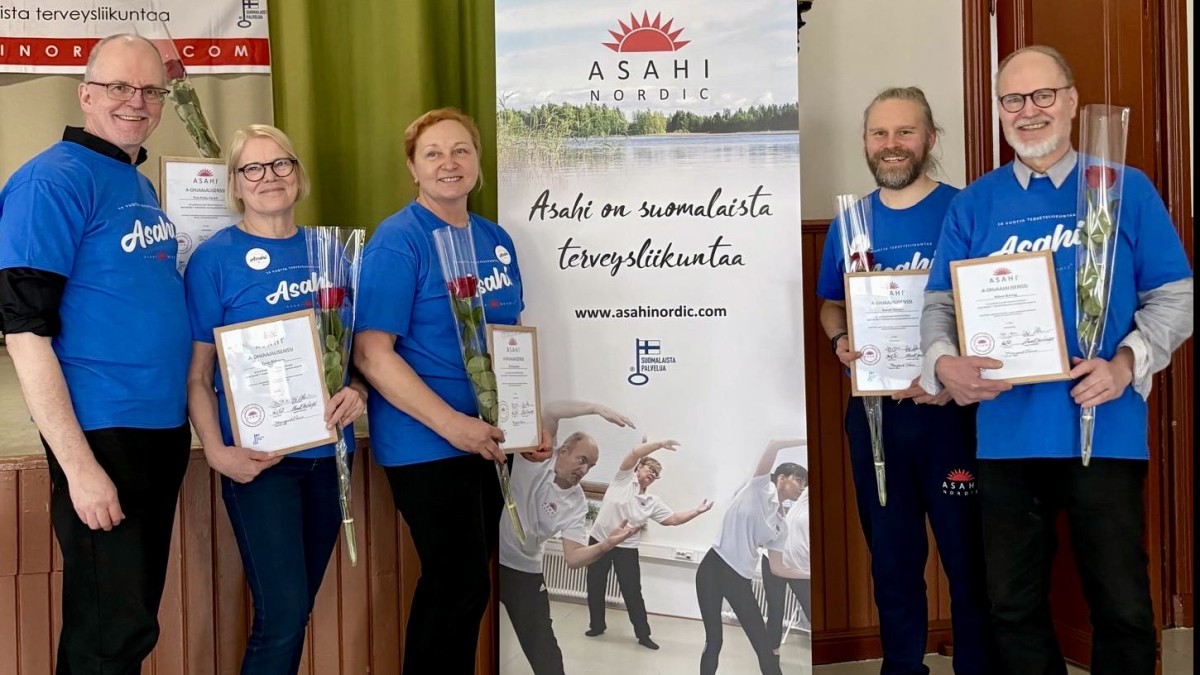
Tuula Riikonen wants to inspire PT's to practice Asahi themselves and with their clients!
Asahi and Physiotherapy – Benefits for Both
How I Discovered Asahi as a Physiotherapist
I came across Asahi quite by chance after joining a senior teachers’ association following my working career; members were offered their own Asahi group in our association. It immediately drew me in!
During my final working years, I experienced remote work. During the COVID period, my exercise habits changed, and group fitness classes — which had always been part of my life — disappeared. Physical activity during the workday decreased significantly. We physiotherapists used to actively take the stairs from our sixth-floor office up and down all day, so we naturally accumulated plenty of steps. Through Asahi, I realized just how stiff my body had become as a result of all this. The gentle exercises gradually relaxed my body, and I became inspired by the idea of training as an instructor myself.
My Professional Background Led Me to Instructor Training
I enrolled in the C-course in 2023, completed the B-course the same year, and began leading my own groups.
My professional background is in physiotherapy. After working in Switzerland at my first job, I became interested in neurology, specialized in neurological physiotherapy in Finland, and worked at a private medical clinic in Joensuu. I later continued my studies toward a Master’s degree in Health Sciences and spent about twenty years in managerial positions at two rehabilitation centers. The final stage of my career was as a lecturer at a university of applied sciences.
With all that experience behind me, discovering Asahi at this stage of life was a pleasant surprise. I now get to do something where I can utilize my background and expertise while also promoting wellbeing for others.
I have led countless different groups and lectures, marketed rehabilitation services, collaborated with companies, various client groups, and students, and so on. I can clearly see opportunities for physiotherapists to make use of Asahi in their work. Physiotherapists are rehabilitation professionals with specialized expertise in promoting movement, functional ability, and health.
Different client groups could benefit from Asahi, including people with musculoskeletal disorders, neurological clients, seniors, people with disabilities, and many others. I have met several people who first encountered Asahi during rehabilitation periods at rehabilitation centers, so Asahi is already known within rehabilitation circles.
How Have Asahi’s Effects Been Experienced in My Groups?
My groups have included elderly participants, working-age adults, and students. Universities and universities of applied sciences have offered exercise groups for both staff and students, while daytime groups at adult education centers are mainly filled with retirees. It is a privilege to guide people of such different ages.
Below are some examples of their experiences.
General Relaxation and Warmth in the Body
A strong feeling after practice is overall relaxation and warmth throughout the body. Participants also notice that their thoughts do not wander elsewhere while concentrating on the movements.
One older woman wondered how her hands stayed warm for such a long time after exercising. Peripheral circulation weakens with age, but Asahi movements effectively stimulate circulation and metabolism.
Relief from Sciatic Pain
One working-age woman reported that her sciatic pain had completely disappeared from her leg. Relief from neural pain radiating into the leg or arm is one example of Asahi’s positive effects.
The spiral movements benefit spinal mobility, help free nerves from compression, and improve circulation to the intervertebral discs. Any change in the experience of pain has a major effect on overall wellbeing.
Muscle Relaxation
Participants frequently report strong feelings of muscle relaxation.
One woman who worked extensively at a computer experienced shoulder pain because her entire neck and shoulder region was extremely tense. Sitting ergonomics likely contributed to the problem. During one session she suddenly exclaimed, “Hey, my shoulders don’t hurt anymore!”
The upper limbs are constantly involved in the movements, and the shoulders receive effective but gentle movement. There is pumping action, spiraling, opening, and closing movements. Muscles in chronically tense areas also strengthen comprehensively.
Increased Mobility
People experience improved mobility in the back, neck-shoulder area, and joints. Asahi movements help hydrate the fascia, which in turn relaxes muscles and improves mobility. Local muscle tightness is also relieved.
Especially the spinal rotation movement receives a lot of feedback regarding increased mobility. The movement begins to feel more relaxed and fluid.
Strengthening the Knees
A young student had been advised by healthcare professionals to strengthen her knees. With that recommendation, she joined the group.
I spoke with her privately and explained that Asahi could be an excellent form of exercise precisely because its movements are gentle yet effective. She attended throughout the winter and was able to improve her muscle strength and support her knee function.
Joy of Movement and Improved Coordination
A woman who had lost a significant amount of weight found Asahi to be an enjoyable and suitable form of exercise. It was wonderful to watch her movement coordination improve during the course and to see her discover genuine joy in movement.
Over time, the movements become more relaxed as coordination improves through practice. Her face radiated happiness as she enjoyed the exercises.
Better Balance
Participants also reported feeling more stable in their balance. Rising onto the balls of the feet, toes, and heels became easier, as did weight shifts in walking positions and movements involving standing on one leg.
All these experiences support everyday mobility situations.
Experimenting with Asahi in Physiotherapy Rehabilitation
I developed an idea: it would be fascinating to see how Asahi affects actual physiotherapy clients and how physiotherapists themselves experience it as a working tool. I believed both could benefit from the experience.
So I contacted a colleague’s company, and we decided to move forward with the experiment. Enthusiasm quickly arose on both sides.
Four physiotherapists participated. I introduced them to the basics of Asahi and the movements of the first series performed standing. Their education and work experience made it easy for them to learn the movements.
In early summer, I also led an outdoor group for them, and their clients were welcome to join. This allowed the therapists themselves to experience being in an Asahi group and to feel the effects of repeated practice firsthand.
Based on this experience, the physiotherapists selected clients whom they professionally believed might benefit from trying Asahi alongside other movement therapies. After the summer holidays, they selected participants for the trial. The goal was to focus on a few clients who would also be receiving longer-term therapy.
In early December, I received a summary of both the therapists’ and clients’ experiences.
Results of the Experiment
The physiotherapists used Asahi with:
- four stroke patients,
- one chronic pain patient,
- one client suffering from anxiety,
- clients with neck and shoulder problems,
- and one client with cerebral palsy (CP), for whom movements were adapted to be performed sitting down.
The physiotherapist independently adapted the exercises for seated performance.
Some clients practiced only individual movements, while the client suffering from anxiety performed several movements in sequence.
Stroke Clients
Stroke clients found the movements quite challenging and physically demanding, but over time they felt the exercises strengthened lower-limb power, balance, and bodily symmetry. Sitting breaks were needed between exercises for recovery.
Chronic Pain Client
One chronic pain patient — who had Tarlov cysts in the sacrum and nerve damage in the left limb following surgery — found the neck and shoulder movements and weight-shifting exercises grounding and relaxing.
The client adopted two movements as home exercises: the first relaxation exercise in the series and the “hawk” movement from the neck and shoulder exercises.
Anxiety Client
For the client experiencing anxiety, the calming opening exercises combined with breathing were grounding, increased body awareness, and promoted relaxation.
The exercises contain similar elements to standing BBAT exercises. Basic Body Awareness Therapy is a psychophysical physiotherapy method developed in Norway that aims to activate a person’s own health-promoting resources through increased body awareness.
Musculoskeletal Clients
For musculoskeletal clients, thoracic spine flexion/extension (closing/opening) and rotational exercises were effective and fairly easy to guide.
The CP client found the seated exercises beneficial, though they could not explain the effects further.
General Observations
Overall, when adapted and individually dosed, the exercises and movement sequences were highly suitable for many clients. They improved mobility, symmetry, and balance.
Performed calmly and combined with breathing, the exercises were restorative, increased body awareness, and relaxed both body and mind.
Since therapy sessions also included other forms of treatment besides Asahi, it was not possible to isolate the exact effect of Asahi alone.
Therapists’ Own Experiences
The therapists also shared personal experiences. Two reported that headaches disappeared during the Asahi group I (Tuula) led, while the next day they experienced normal muscle soreness in the lower limbs.
Two others experienced neck and shoulder tension and headaches the following day, apparently because scapular support weakened during arm exercises performed above shoulder level.
We discussed the importance of scapular support and how the shoulder blades support arm movements. At the physiotherapists’ request, the groups were always held after the workday before going home.
Final Thoughts
The experiences have been encouraging both in my groups and in physiotherapists’ work. Asahi brings variety to therapy and supports rehabilitation alongside other treatments.
Movements can be selected according to the client’s rehabilitation goals and also assigned as home exercises.
It would be beneficial to gain more research-based evidence. Students at universities of applied sciences have already completed individual theses on Asahi. There are many groups across Finland, offering excellent target groups for collecting feedback and conducting studies.
Case studies from the perspective of physiotherapy would be especially interesting. What we need are physiotherapists who become as inspired by Asahi as I have been. My own enthusiasm and experiences certainly encourage further research!
Asahi could also be a useful tool for nurses and social workers. Many work in organizations, associations, and companies where Asahi could benefit both groups and individual clients — for example in elderly care, mental health and substance abuse services, early childhood education, and family homes.
Personally, I am enthusiastic and grateful to have found Asahi and all the others who have become passionate about it — both my participants and instructors throughout Finland.
Various events have emerged around Asahi where people meet and share experiences. In addition to training programs, there are summer events and health days where one always encounters new people, new knowledge, and valuable exchanges of experience.
This is how Asahi continues to grow and gain recognition. I myself have had the opportunity to help increase awareness in North Karelia. From the very first “Get to Know Asahi” event, several people went on to C-training, and some have already completed B-training as well.
I encourage everyone in their own local area:
Spread Asahi forward!
Categories: : Asahi & Chronic Pain, Asahi & Osteoarthritis, Asahi & Physical Therapy, Asahi and Chronic Neck Pain, Asahi and Exercise Physiology, Asahi Nordic for a lifetime, Asahi Nordic for All, Asahi teachers' close-ups